LOS pricing model

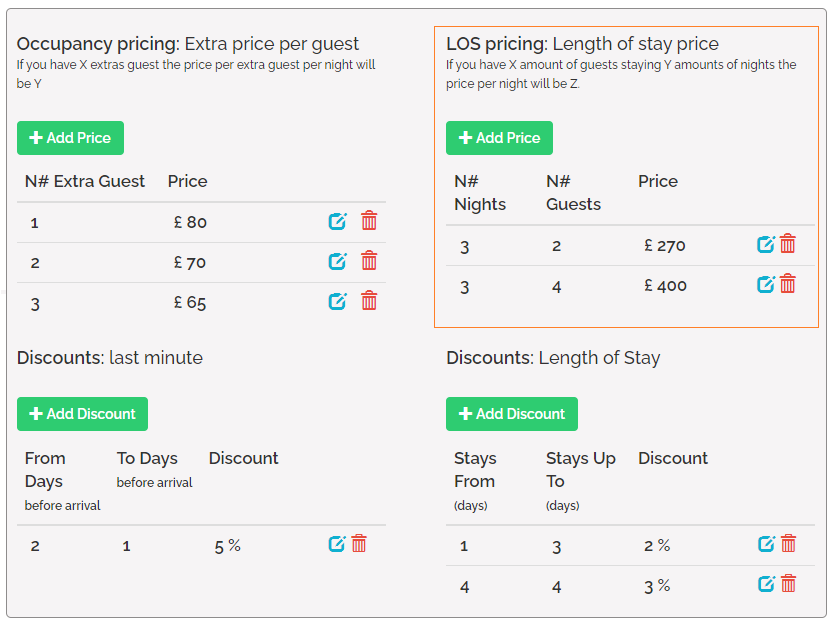
In LOS pricing, it is possible to specify fixed nightly pricing plans for different numbers of nights and (optionally) for different number of guests. It means that your prices can depend on the number of booked nights and guests staying at your property.
Here is how LOS pricing works. For example, let's say your Daily price is 200 USD. If you continue using the Daily price model and one guest decides to book your property for three nights - the total is 600 USD.
In case you use LOS pricing, you can easily set that one guest pays a different amount per night, depending on how many nights were booked. For example, 1 guest can pay 200 per night if a 3-night stay was booked - the total is 600 USD. But you can easily set that 1 guest can pay 190 USD per night if a 4-night stay was booked - the total is 760 USD.
You can do the same for the number of guests and set different prices for different cases. You can see more examples as well as how to correctly set it at LOS pricing.
|
|
FSP pricing model
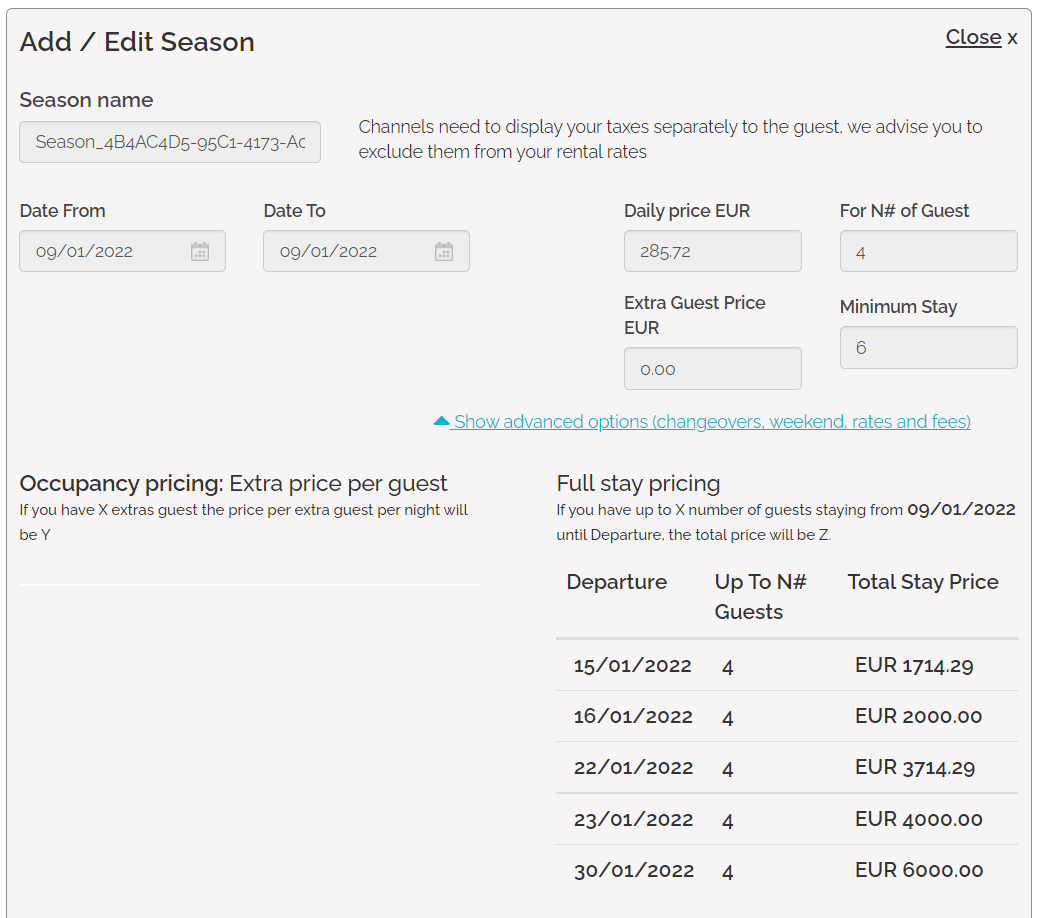
FSP pricing model can be used if you are a PMS or an API user. It defines a fixed price for the whole stay, that is for an exact number of guests and nights.
-
Note that it will not be possible to make a reservation for a period in which prices are not defined.
-
Note that FSP pricing does not respect Standard number of guests or Maximum number of guests. Whatever is provided as the FSP records will be respected.
Example 1: Your standard number of guests = 4 and you provided prices only for 1 and 2 guests.
Result: The reservations with 3 and 4 guests will not be possible.
Example 2: Your maximum number of guests = 4 and you provided prices only for 5 and 6 guests.
Result: The reservations with 5 and 6 guests will not be possible.
|
|
Daily price model
Daily price model calculation is based on the values retrieved from various data fields. It allows for detailed pricing settings if set carefully. Also, Daily price model is based on seasons.
The season refers to a period of time when particular pricing is applied. It is possible to set as many seasons as required, varying in length and specification. The minimum settings require:
-
Season name,
-
Date range,
- Price.
Daily price
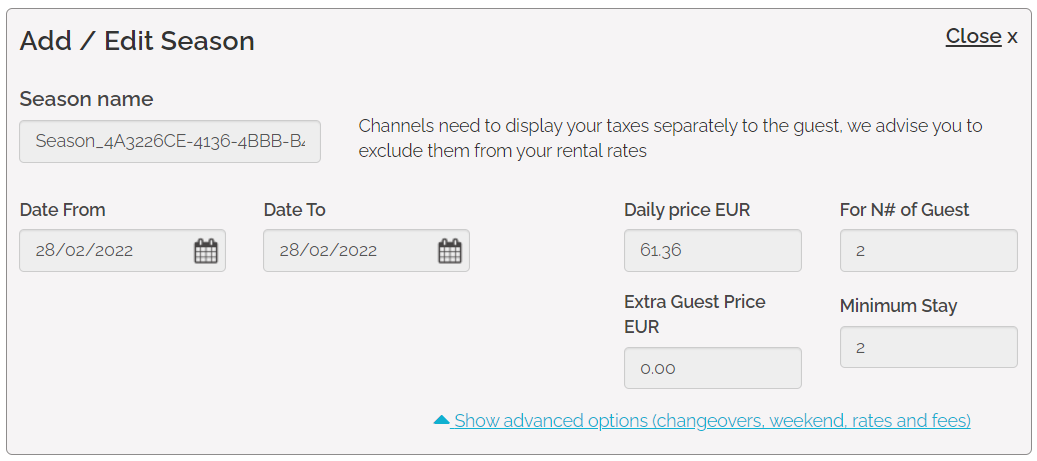
Daily price is the standard way of setting prices. It indicates the base price per night for the Standard number of guests.
|
|
Standard number of guests
Standard number of guests refers to the maximum number of guests included in the Daily price for whom the price does not change. If more guests than specified book a stay, the extra guests will be charged with the price set in the Extra guest price element.
|
|
|
Extra guest price
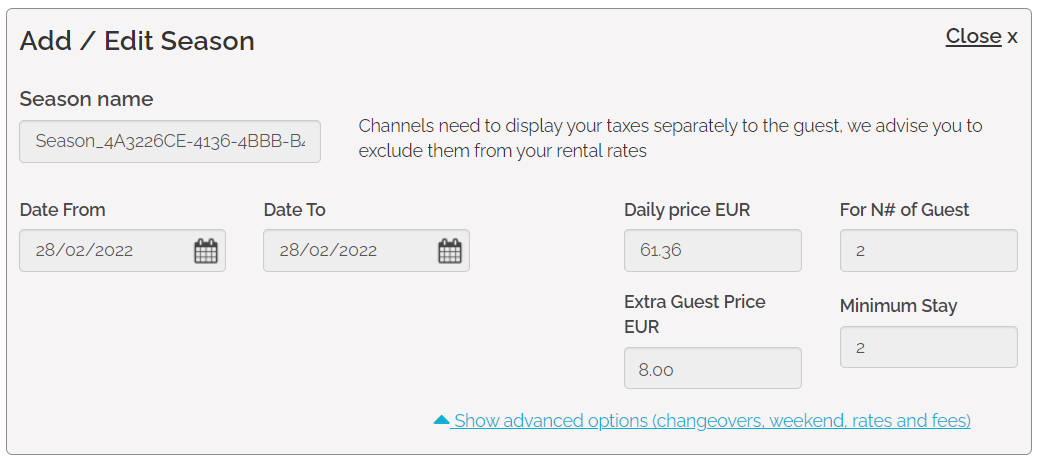
Extra guest price is the price for guests that are not included in the Standard number of guests. In other words, if the overall number of guests exceeds the Standard number of guests, Extra guest price is applied for each guest above the specified standard.
If there is only one matching rule, we treat it as Extra guest price. The "fixed_amount" parameter indicates the Extra guest price value. In this case, it is 10. If there are more rules, see Occupancy pricing.
|
|
Weekend pricing (N/A)
Occupancy pricing
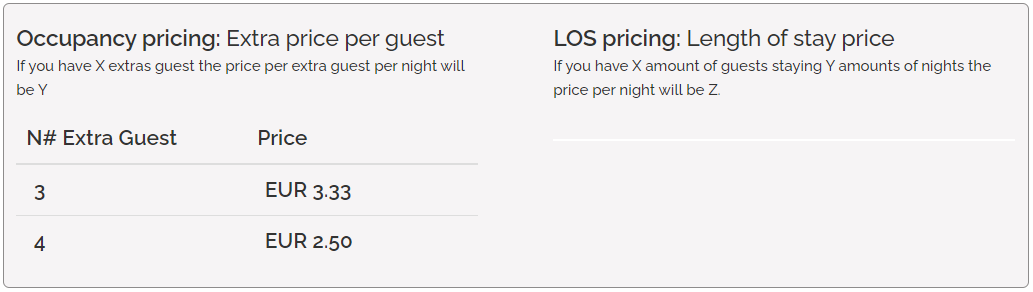
In Occupancy pricing, it is possible to specify pricing plans for different numbers of guests. The difference between Extra guest price and Occupancy pricing lies in fact that with Extra guest price the same price is applied for each extra guest. On the other hand, in Occupancy pricing it is perfectly possible to specify different prices for different numbers of guests. Note that Occupancy pricing takes precedence over Extra guest price.
Occupancy pricing is calculated in the following way:
The "occupation_greater_than": "4" parameter denotes that the price is for 5 guests in total. Since the Standard number of guests in this case is 2, there are 3 extra guests. Then, the amount from "fixed_amount" parameter is divided by the number of extra guests and totals 3.33.
The "occupation_greater_than": "5" indicates the price for 6 guests in total. Standard number of guests in this case is 2, there are 4 extra guests. Then, the price per guest if there are 4 guests totals 2.5.
|
|
Complimentary topics
Discounts (N/A)
Calendar
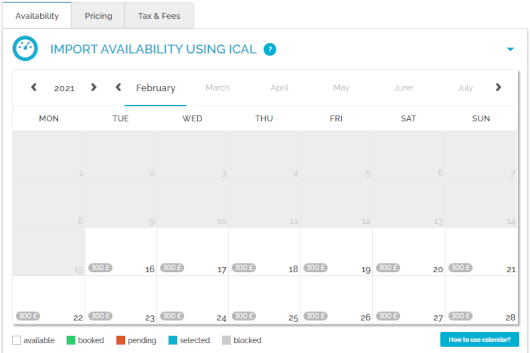
Calendar stands for the property's availability to rent. You can check here the availability of your property in the selected time frames. Once a reservation is inserted in Rentals United, the availability in the calendar gets blocked for this period. The calendar is updated automatically every time the availability of the property changes or at predefined times to remain up-to-date.
Every time availability is retrieved from Smily, Rentals United receives it in a 1096-digit format. Every digit represents one day in which a property is available or not, starting from "start_date" date.
|
|
Preparation Time Before Arrival (N/A)
Changeover restrictions
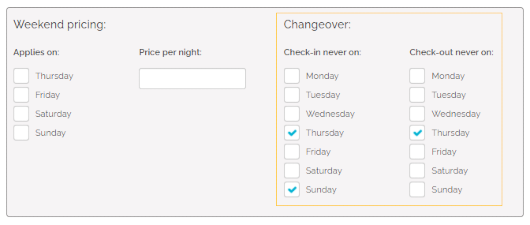
Changeover restrictions specify whether check-in or check-out is allowed for a given day. This is a great option if you need the guests checking in and out to fit your schedule and it will help you avoid unexpected guests. If some days are restricted from changeovers, then your guests will simply not be able to select such a stay if the start or end day falls on a changeover-restricted day.
Smily returns a 1096-character string in the "map" parameter. Every character represents one day in which guests can or cannot check in or check out, starting from the "start_date" date.
|
|
Tax
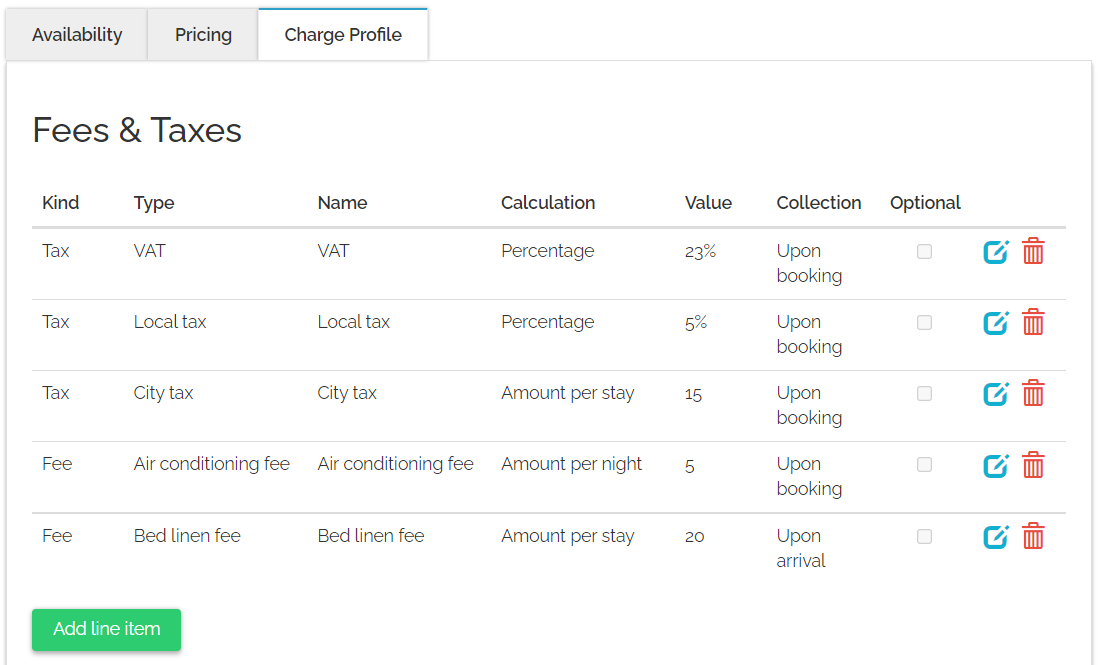
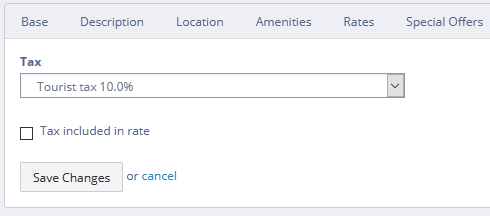
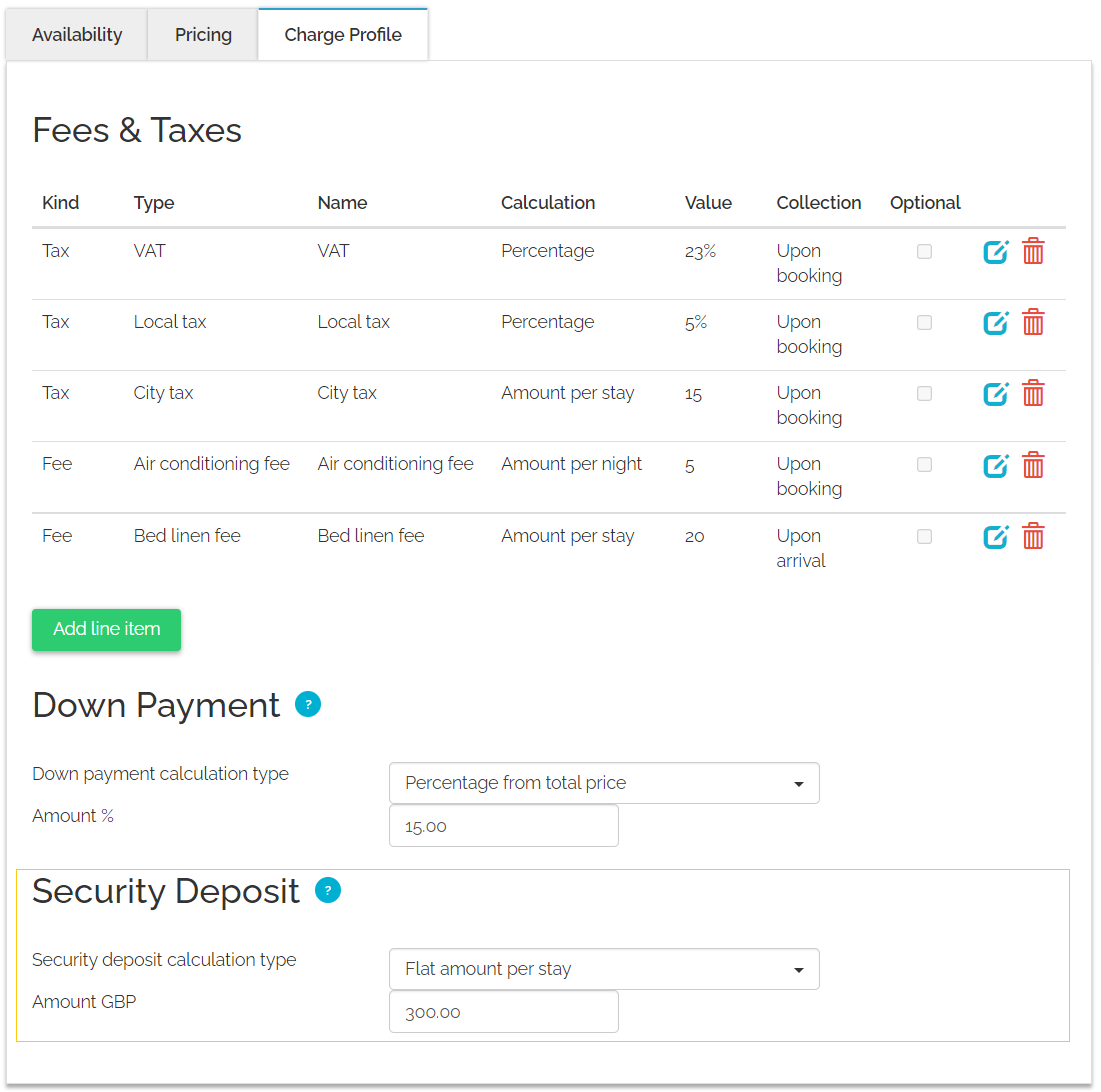
Tax refers to mandatory charges legally levied on particular types of goods, services and transactions, paid as a contribution to the state’s revenue, for example VAT or city tax.
By default, synchronization of taxes has been switched on for all Smily clients joining from October, 2020, onwards. Note that for clients that had been working with Rentals United prior to the completion of the development of this feature, the synchronization is switched off.
Taxes are synchronized from Smily to Rentals United when:
-
they are not marked as included in rate in Smily
-
their application period starts earlier than today and ends later than on the last day of the current year
| Smily | Rentals United fee type |
|---|---|
| City tax | City tax |
| City tax fee | City tax |
| Goods and services tax | Goods and services tax |
| Government tax | Local tax |
| Harmonized sales tax | Local tax |
| Hot spring tax | Tourist tax |
| Local council tax | Local tax |
| Municipality fee | City tax |
| Other | Local tax |
| Provincial sales tax | Local tax |
| Residential tax | Tourist tax |
| Sauna/fitness facilities tax | Tourist tax |
| Spa tax | Tourist tax |
| VAT | VAT |
|
|
Fee
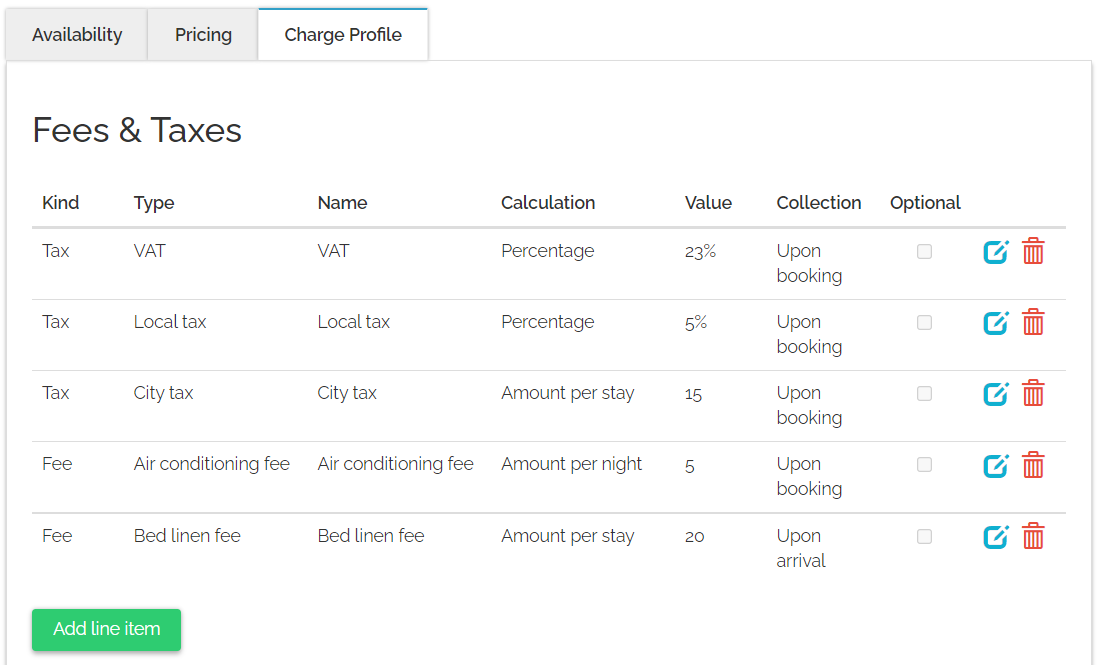
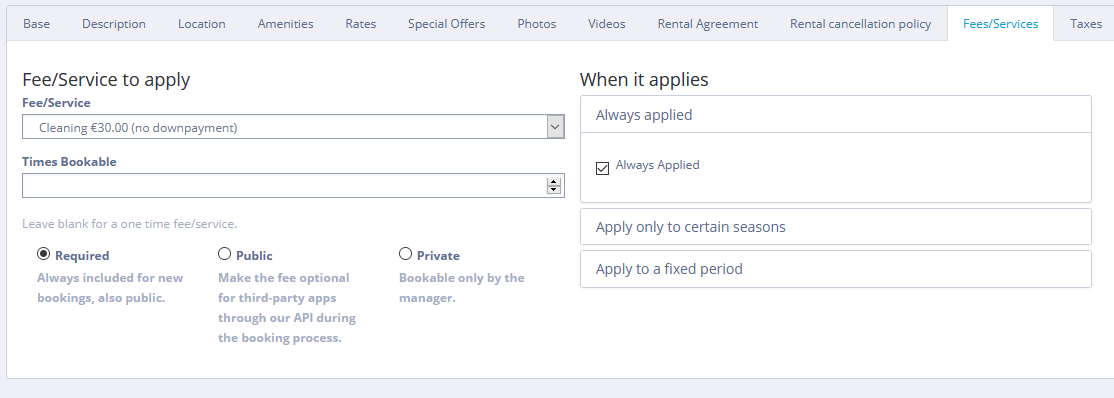
Fee refers to mandatory or optional charges paid in exchange for particular services. These include:Charges for additional services, for example Internet access or shuttle.
Fees defined by local governments that do not fall into the tax category, for example environmental fees.
Fees are synchronized to Rentals United when:
-
they are set to required in the Smily
-
they are always applied or the application period of the fee starts earlier than today and ends later than on the last day of the current year
| Smily | Rentals United fee type |
|---|---|
| Other | Service fee |
| Air conditioning fee | Air conditioning fee |
| Airport shuttle fee | Airport shuttle fee |
| Bed linen fee | Bed linen fee |
| Cleaning | Cleaning fee |
| Club card fee | Club card fee |
| Conservation fee | Conservation fee |
| Credit card fee | Credit card fee |
| Destination fee | Destination Fee |
| Electricity fee | Electricity fee |
| Environment fee | Environment fee |
| Final cleaning fee | Cleaning fee |
| Gas fee | Gas fee |
| Heating fee | Heating fee |
| Heritage charge | Destination Fee |
| Housekeeping fee | Housekeeping fee |
| Internet fee | Internet fee |
| Kitchen linen fee | Kitchen linen fee |
| Linen package fee | Linen package fee |
| Oil fee | Oil fee |
| Parking fee | Parking fee |
| Public transit day ticket | Not mapped |
| Resort fee | Resort Fee |
| Sea plane fee | Sea plane fee |
| Service charge | Service fee |
| Shuttle boat fee | Shuttle boat fee |
| Ski pass | Ski pass |
| Tourism fee | Tourism Fee |
| Towel charge | Towels fee |
| Transfer fee | Transfer fee |
| Visa support fee | Visa support fee |
| Water park fee | Water park fee |
| Water usage fee | Water usage fee |
| Wood fee | Wood fee |
| Wristband fee | Wristband fee |
|
|
Down payment
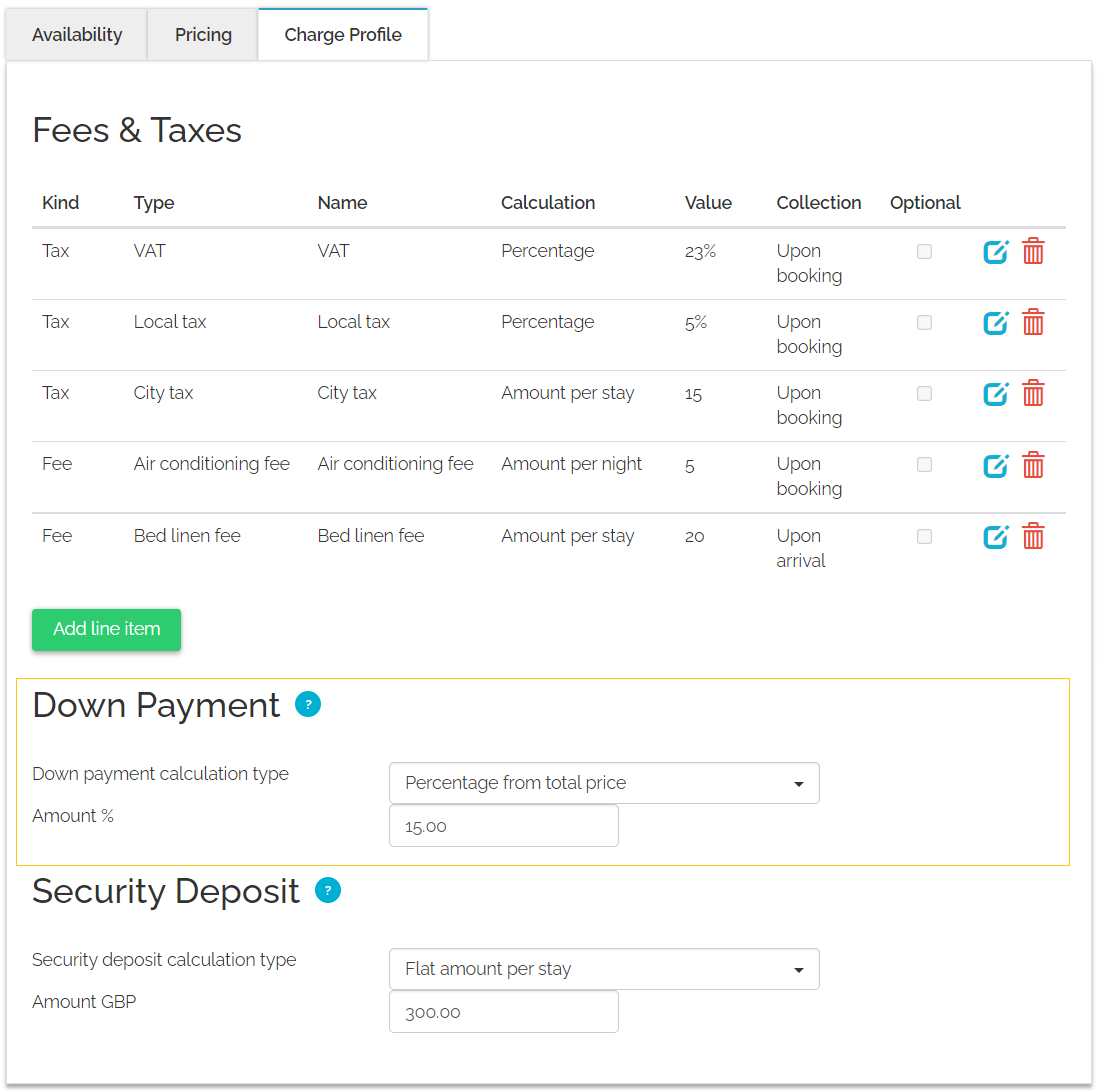
Down payment is a mandatory or optional charge the guest needs to pay to confirm the reservation at this property. The outstanding balance will be charged upon the guest’s arrival.
|
|
Security deposit
Security deposit is a mandatory or optional refundable charge the guest needs to pay to cover for potential property damages.
|
|
Currency
Currency in Rentals United is a fixed value, by default established on the basis of the property location. The currency of any property can be checked in Rentals United, go to Step 5: Price and availability after selecting All properties tab.
Therefore, if the property's currency does not match the one of the city the property is located in, the currency defined in PMS will not be synchronized. In such a case, the currency from PMS will be converted to the currency of the city.
